Seaway Shipman 80 · Hull No. 2
Bambochip
The Shipman Flagship
24 metres · Full carbon-epoxy construction
The Vision and the Builder
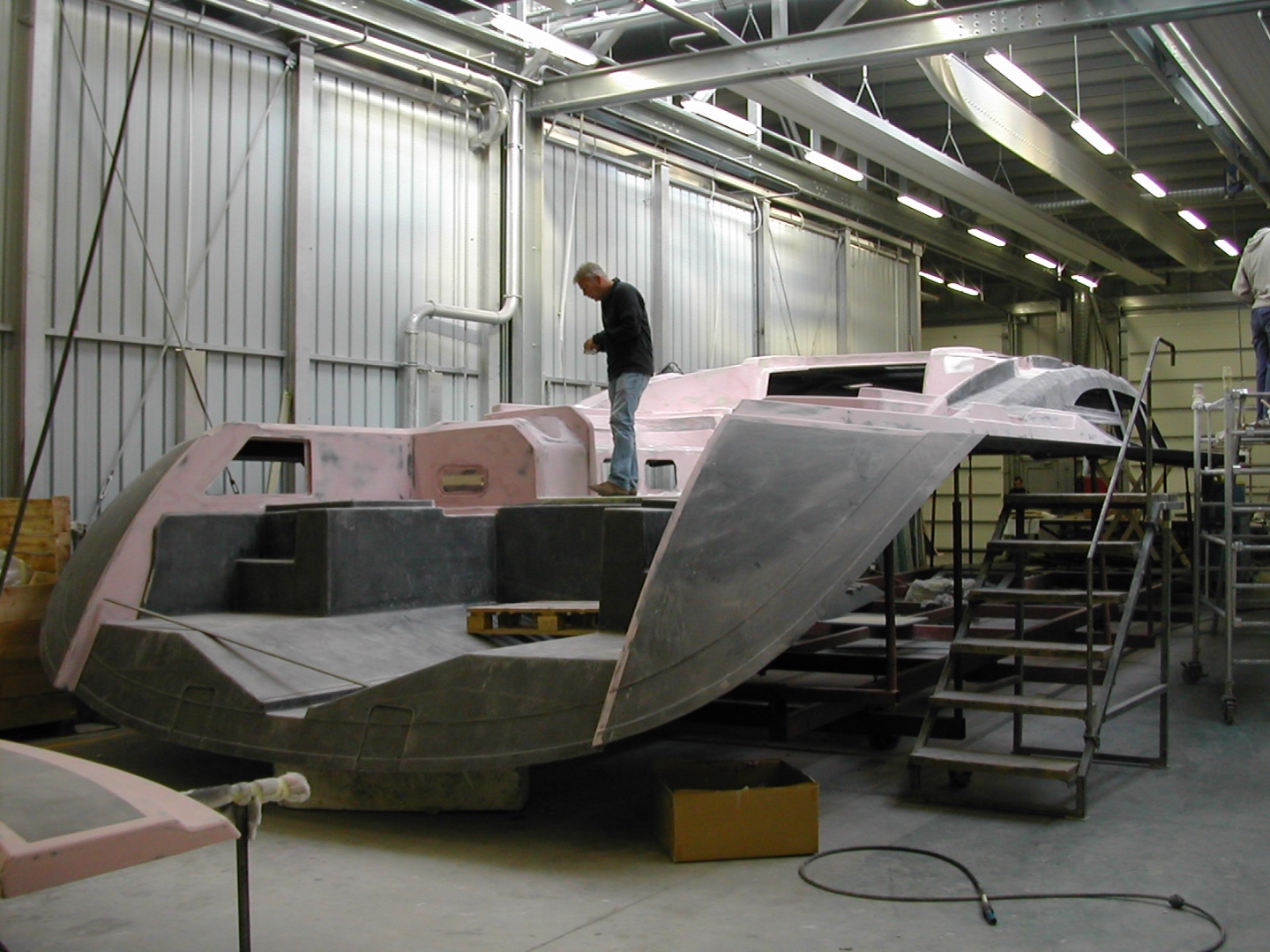
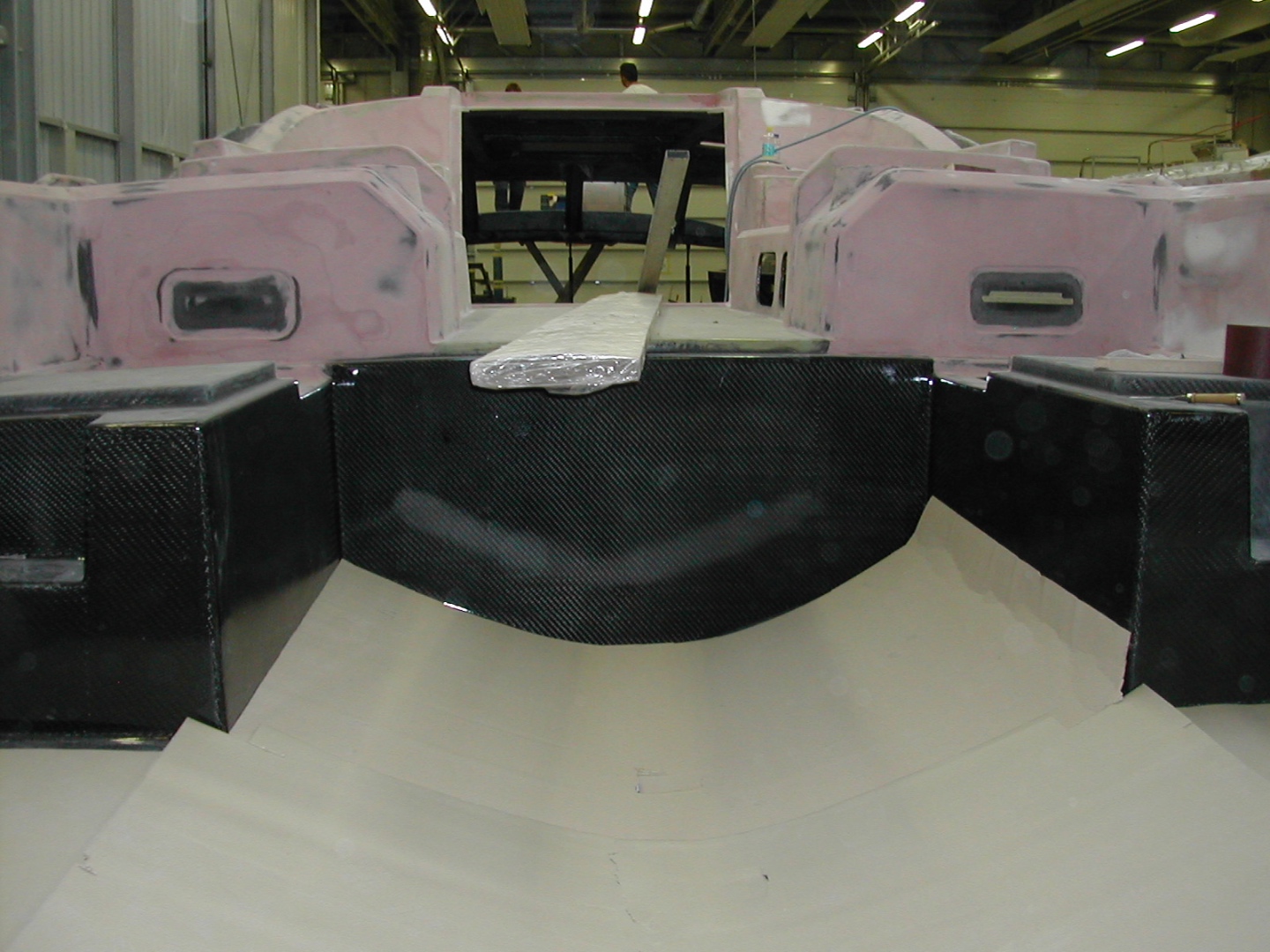
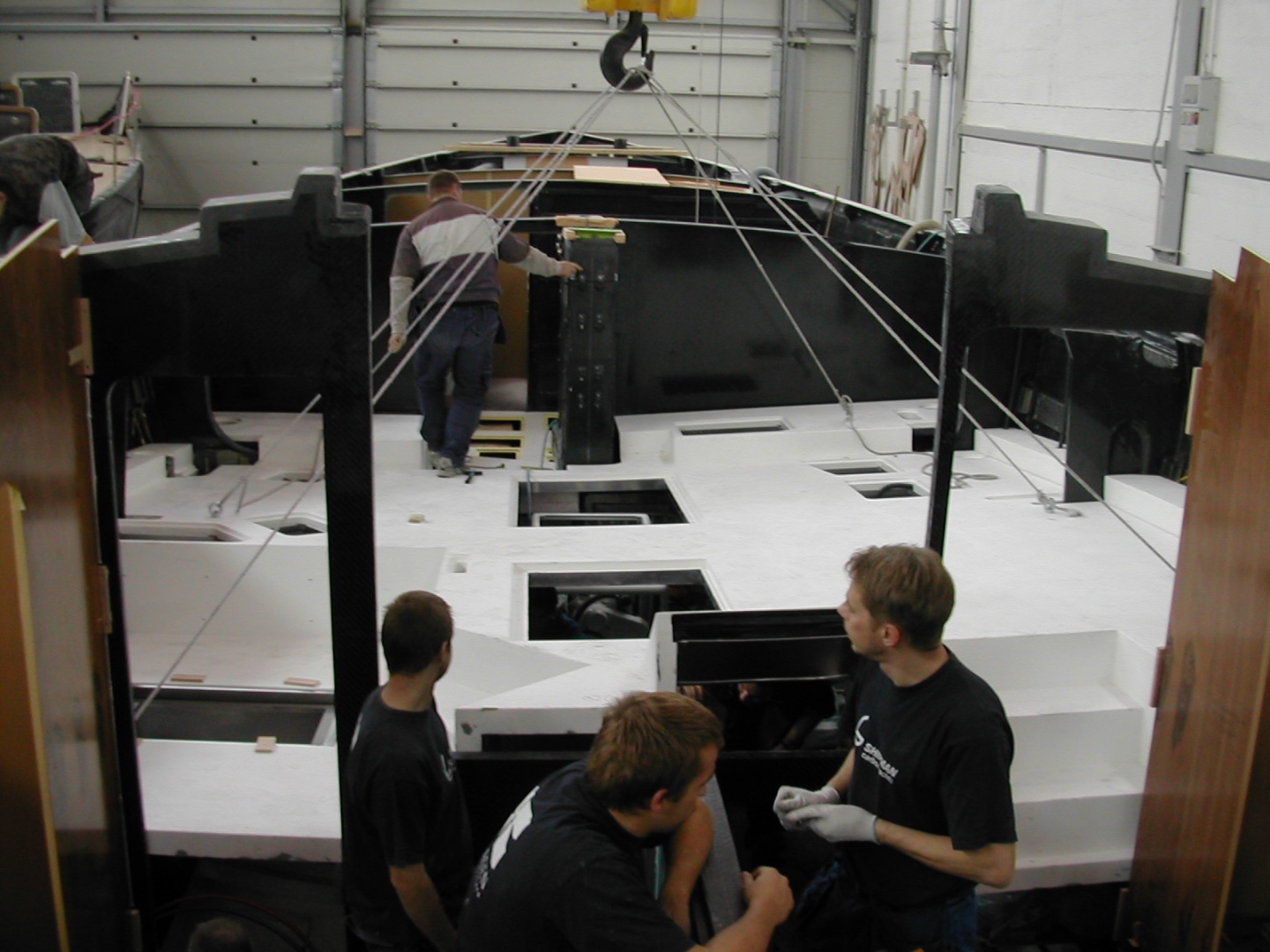
In the mid-2000s, a Slovenian boatbuilder named Seaway undertook the most ambitious project in its history: a fully carbon-fibre sailing yacht of eighty feet, designed for blue-water passage-making at performance ratios that bordered on the improbable.
The Shipman line had already established Seaway's reputation in the fifty- to sixty-three-foot range, lightweight, stiff-hulled cruiser-racers drawn by J&J Design of Ljubljana, whose hull shapes traded on a decade of computational fluid dynamics refined against the realities of the Adriatic and beyond. The Shipman 80 was the natural culmination: the largest yacht Seaway would ever produce, and a platform intended to prove that carbon-epoxy construction, vacuum-infused to aerospace tolerances, could deliver a genuine ocean-crossing yacht weighing less than most sixty-foot cruising boats.
Three hulls were laid. Hull number one, Paula Rosa, established the mould. Hull number three, Ivanka, was built to a capable but standard specification. Hull number two was different. It was commissioned by a man whose family had shaped the course of international sailing for half a century, and who intended it to be the finest sailing yacht of its size afloat.
Seaway would later face financial difficulties in the recession of the mid-2010s, eventually re-emerging to continue its Greenline series of hybrid-electric powerboats. The Shipman line, the sailboats that built the yard's name, ended with these three hulls. They still exist. The yard's sailboat chapter does not. This makes each Shipman 80 not merely a yacht but a record of a builder at the peak of its ambition, frozen in carbon fibre.
Commissioning a Masterpiece
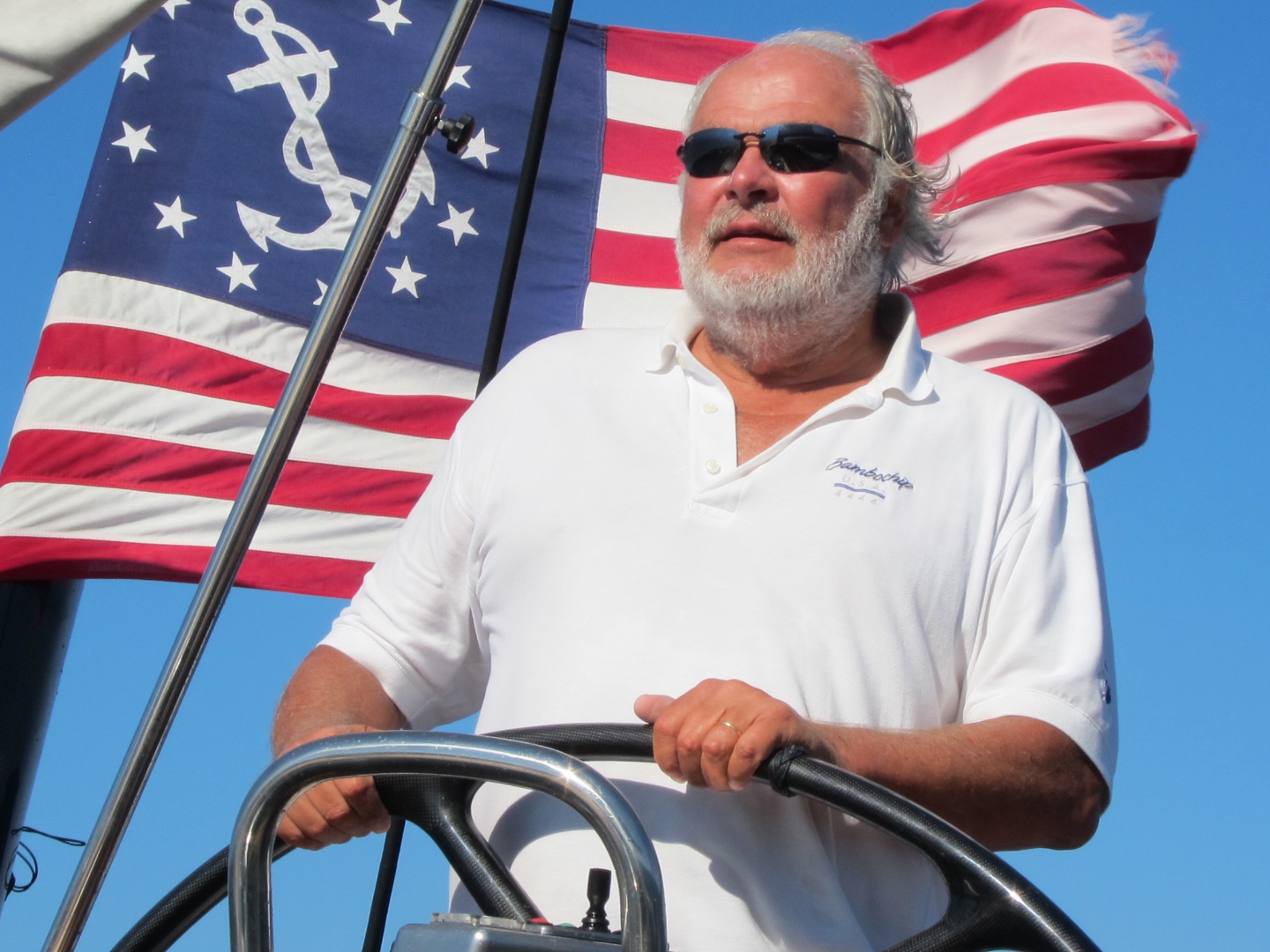
Bruno Bich was the heir to one of France's great industrial dynasties and one of its most consequential sailing families. Together with his father, Marcel Bich, the founder of the Bic empire of pens, lighters, and razors, he mounted three America's Cup challenges for France, the first by a French syndicate and the first by any non-English-speaking nation. Their challenges would forever change the America's Cup.
Marcel and Bruno together purchased the Dufour shipyard and a constellation of sailing hardware manufacturers, driven by an ambition to produce every component of a French racing campaign on French soil. The Bich family name is inseparable from the history of French competitive sailing, and from a philosophy that treated yacht ownership not as consumption but as custodianship.
Bruno had already owned a Shipman 63, delivered in 2003, which he handed to his brother when the eighty-foot platform was delivered. He knew the builder, the naval architects, and the carbon laminate schedules intimately. When he committed to Hull number two, he did so with a negotiating precision worthy of his commercial reputation: 100% deposit placed with Slovenia's principal bank, a deal structured to lock in a fixed-price and terms which reflected his seriousness and his leverage.
But the deposit was only the beginning. Bruno chose Hull number two deliberately, not the first, but the second. His team would observe the construction of Hull number one in its entirety, inspect the finished product, identify every improvement, and incorporate them into their own vessel. He dispatched a naval architect and project manager to live in Slovenia for the duration of the build. Alongside them went a former Olympic sailor who would go on to serve as Bambochip's long-term captain.
The result was not merely a Shipman 80. It was a Shipman 80 as reimagined by a family that had spent a generation building and racing yachts at the highest level, supervised by professionals who understood that this vessel would be Bruno Bich's final yacht. It had to be a vessel which would not only put purpose-built racing boats to shame, it also had to serve as his floating pied-a-terre, a working office, and the unofficial embassy of the Bic Group.
The Engineering of Lightness
At eighty feet, Bambochip weighs thirty-eight tons, less than many production cruising yachts of sixty feet. Every system aboard was selected, specified, or custom-engineered to preserve that margin of lightness without sacrificing a gram of structural integrity, a watt of capability, nor a single degree of comfort.
Kevlar Reinforcement
Bruno specified a modified laminate schedule incorporating a layer of Kevlar below the waterline and extending thirty centimetres above it, a massive upgrade to the standard carbon layup. This reinforcement provides ballistic-grade impact resistance in the zone most exposed to flotsam, grounding, and collision. The same upgrade was offered to Hull number three; the owner of Ivanka declined, due to the $400,000 upcharge. Bambochip is the only Shipman ever built to this specification.
Crash Compartment
A dedicated crash compartment was engineered into the bow, designed to absorb a high-speed impact and contain flooding to a sealed forward section without compromising the integrity of the main hull. In a vessel built to cross oceans and make fast passages in remote waters, this is not a theoretical provision. It is operational insurance.
Titanium Hardware
All stanchions, pulpits, railings, most of the metal hardware on the yacht were custom fabricated in G5 titanium by a specialist UK workshop. Titanium never corrodes, is roughly one-tenth the weight of marine-grade stainless steel with added strength, and approximately twenty times the cost. The decision reflects the governing logic of the entire build: every kilogram saved above the waterline lowers the centre of gravity and improves stability under sail.
Cariboni Hydraulics
The hydraulic systems, keel lifting, backstay tensioning, and auxiliary functions, were engineered by Cariboni, the same Italian firm that builds systems for the AC75 class and the Perini Navi fleet, including Magic Carpet. The system is bespoke, not catalogue.
Hall Spars Carbon Rig
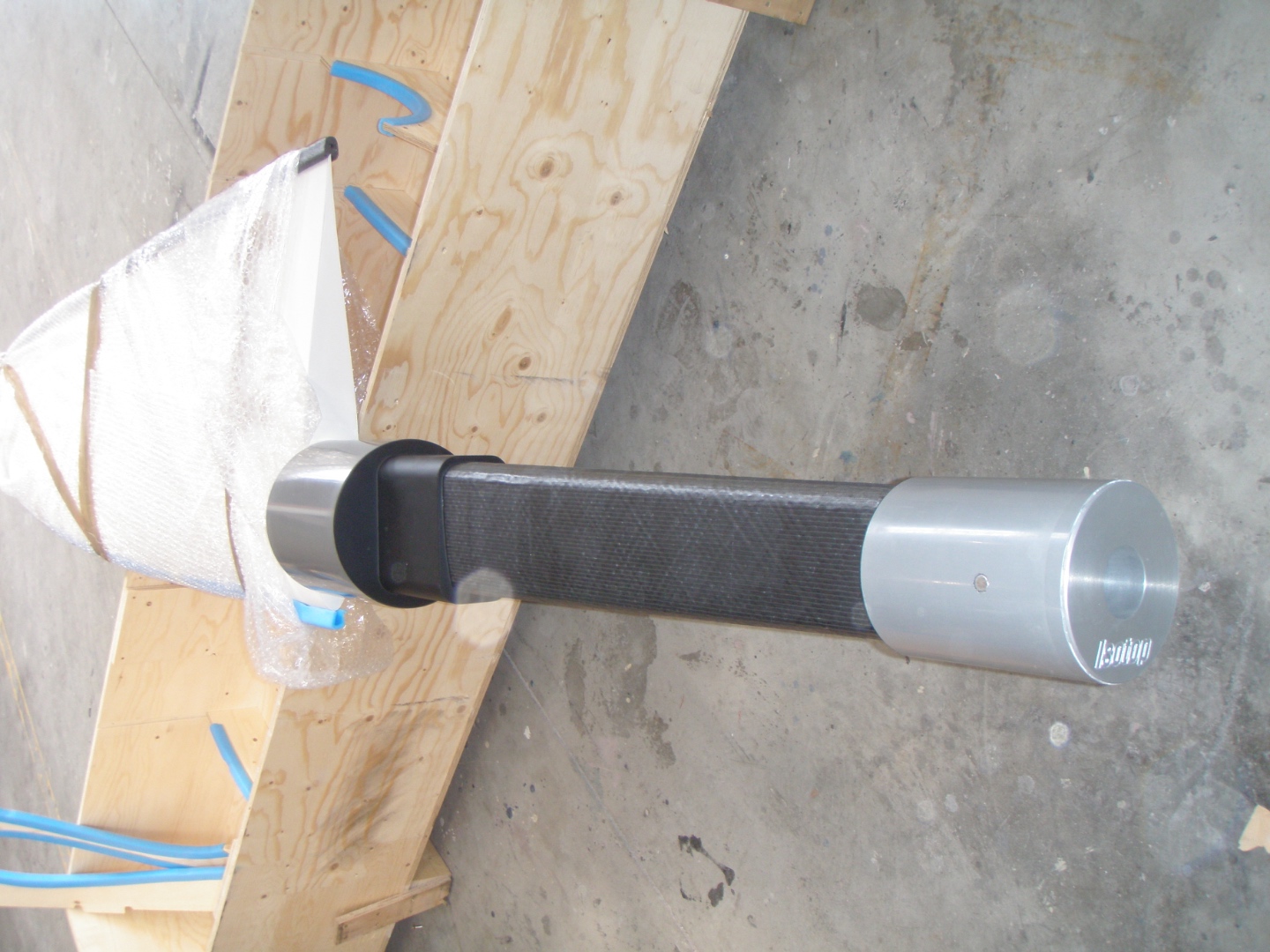
The mast and boom are Hall Spars carbon fibre, the top-range choice for high-performance sailing yacht rigs worldwide. Where the other Shipman 80s carry heavy stainless steel rod rigging, Bambochip was spec'd to utilise composite rigging. Titanium hardware built by Navtec where metal fittings are necessary. 2025 refit included second generation synthetic rigging, continuously wound Dyneema, "Para-D by Colligo."
Mastervolt/Victron Electrical
The original electrical system was not merely supplied by Mastervolt but engineered and installed by Mastervolt's own technical team, a level of manufacturer involvement typically reserved for superyachts of significantly greater size and budget. Every circuit, every distribution panel, every connection was executed to the manufacturer's internal standards rather than a yard electrician's interpretation of them. In 2025, Victron was engaged to design and install an extensive upgrade package which has modernised the vessel, benefiting from greatly improved autonomy and a reduced carbon footprint.
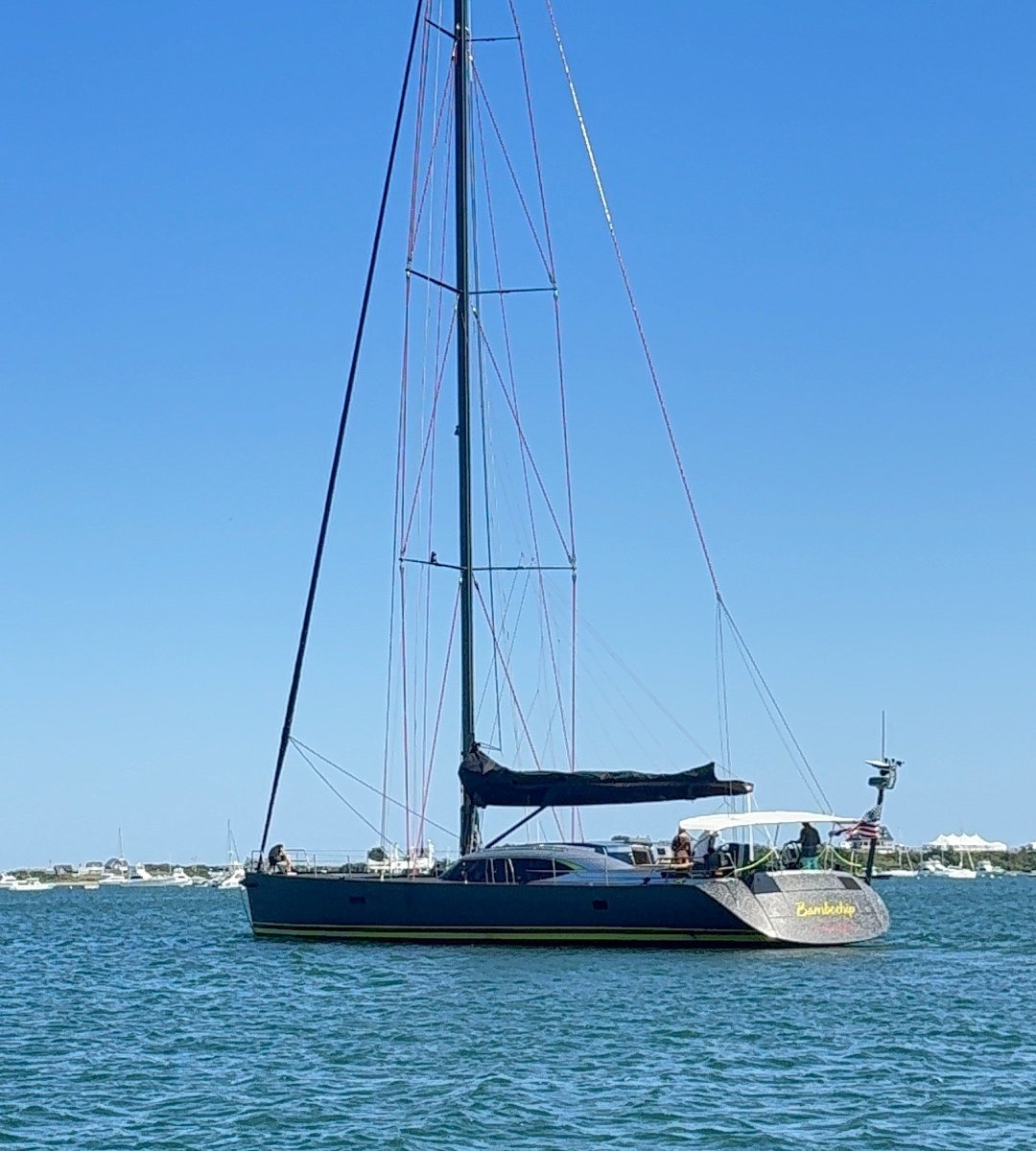
The retractable carbon-fibre bowsprit, the larger-than-standard sail locker designed to carry a full offshore inventory, and the lifting keel with its 2.5- to 4.0-metre draft range complete a picture of a yacht engineered for versatility as much as speed, equally at home in the shallow anchorages of the Bahamas and the deep swells of the North Atlantic.
Silence and Comfort
Bruno Bich wrote a forty-decibel noise limit into the build contract. With the generator running and the air conditioning at full output, the interior of Bambochip was to be no louder than a quiet living room. Audio specialists would attend delivery with measurement equipment, and if the limits were exceeded, the yacht would be refused.
This was not a casual aspiration. Carbon-fibre hulls, for all their structural and weight-saving virtues, are acoustically unforgiving. They are stiff, resonant, and transmit sound and vibration with a fidelity that fibreglass absorbs. Bruno had learned this firsthand aboard the Shipman 63, where the thin carbon shell amplified wave impact and mechanical noise in ways that compromised liveability on extended passages.
Seaway initially struggled to meet the target despite deploying audiophile-grade insulation throughout the hull and machinery spaces. The breakthrough came from the generator. A custom Northern Lights unit was specified and modified to operate at just 1,500 RPM, significantly below the standard operating speed. At this reduced speed, the generator produces power with markedly less vibration and acoustic output. As a secondary benefit, the lower RPM extends the mechanical life of the unit, which runs under less stress at every operating hour.
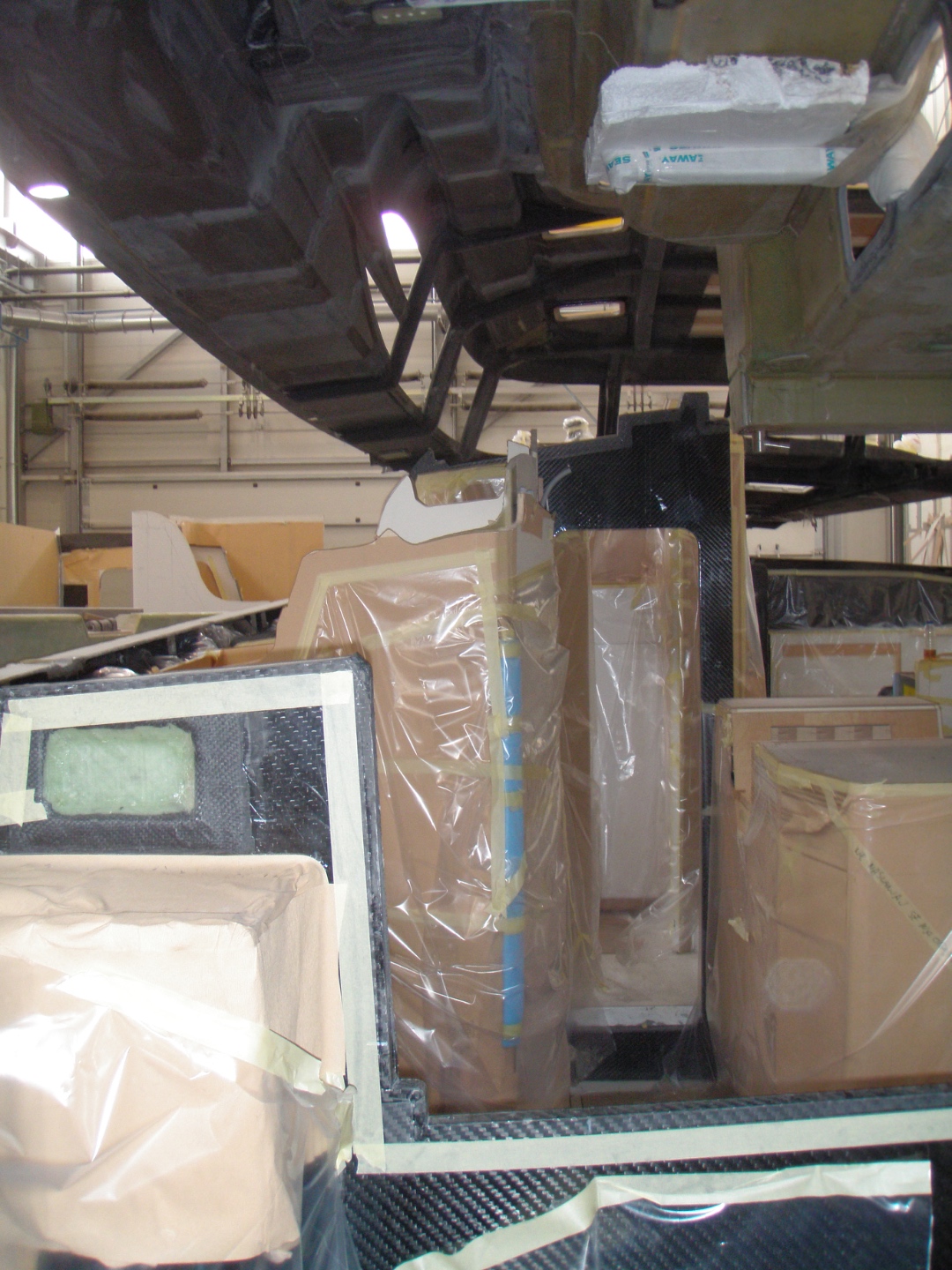
The entire hull interior was then lined with lightweight closed-cell foam, not merely in the engine compartment but throughout the vessel, to decouple the living spaces from the carbon structure. The effect is transformative. Wave impact, which on an uninsulated carbon hull can sound like a drum strike, is absorbed into silence.
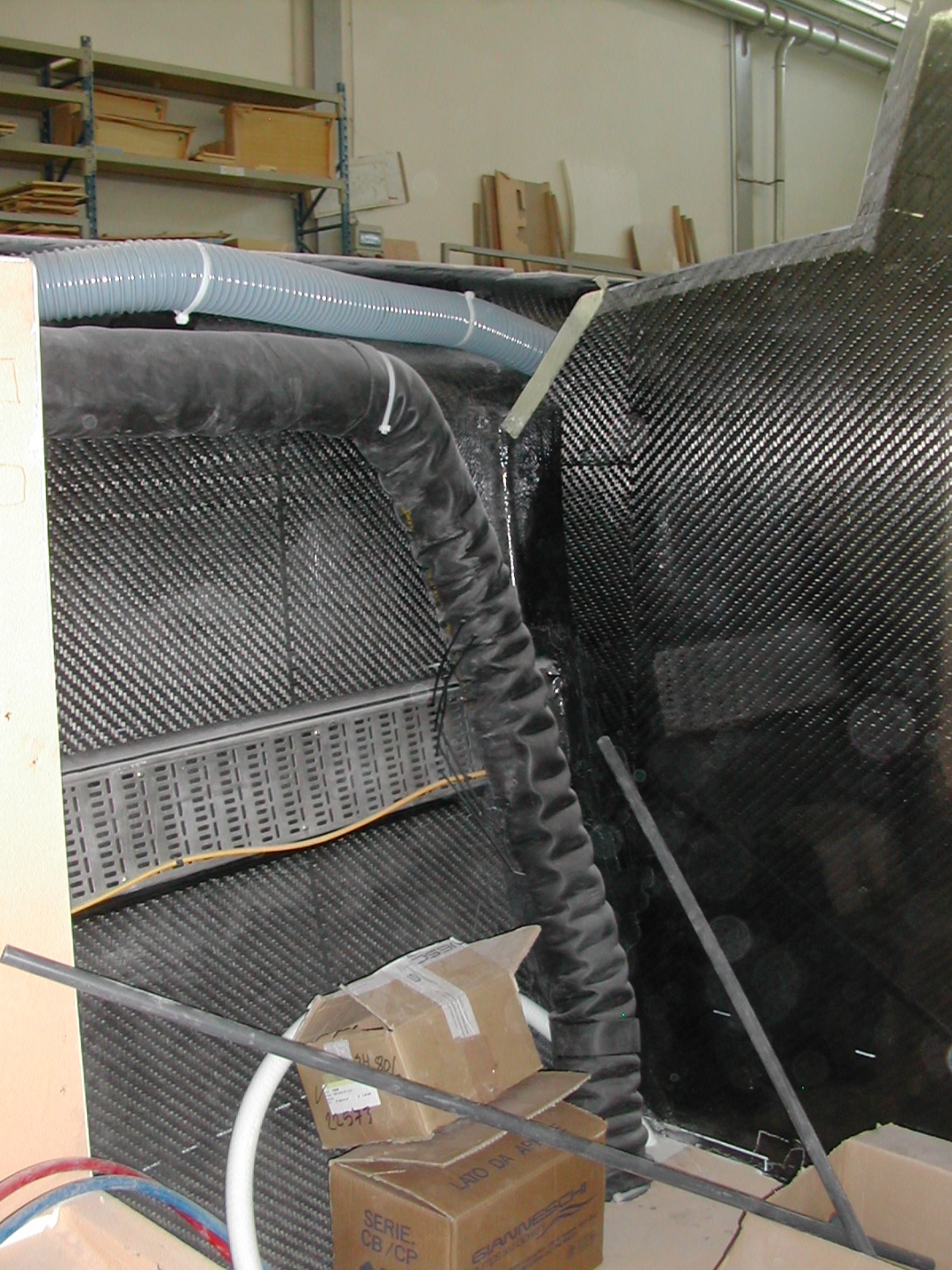
The ventilation system was designed by Silver Pearl Ltd of Poland, specialists in composite ductwork for performance sailing yachts. The system uses custom composite ducting rather than the flexible aluminium typically found on production yachts, routed to deliver conditioned air to every cabin and living space without the turbulence noise that conventional ducting produces. Gianneschi blowers and precision pumps, Italian-made, superyacht-grade equipment, drive the system. Every component is mounted on isolation bushings. Other Shipman 80s carry standard marine-catalogue pumps. Bambochip does not.
The result is a yacht that, at eighty feet and at anchor with every system running, is quieter than most yachts with engines-off.
Design and Interior
The interior was designed by Rhoades Young, an award-winning studio whose portfolio is dominated by superyachts of considerably greater length. Their involvement in an eighty-foot sailing yacht reflected both the ambition of the commission and the personal relationship with Bruno Bich, who demanded a standard of living aboard that matched the engineering beneath the skin.
The visual impression below decks is of rich, warm timber, the kind of hand-finished joinery one associates with the finest motor yachts. The reality is more technically remarkable. Every surface that appears to be solid wood is in fact a thin veneer, vacuum-bagged over a foam-core sandwich panel. Doors, cabinets, drawers, bulkheads, and furniture are all constructed this way. A cabinet door, for instance, which on a conventionally built yacht might weigh several kilograms, balances on a single finger.
This is the governing paradox of Bambochip's interior: it is more luxuriously appointed than most sailing yachts of comparable size, yet every element has been engineered to contribute to the vessel's exceptional lightness. The luxury is not in spite of the performance; it is a consequence of the same obsessive engineering that produced the carbon hull and the titanium deck hardware.
The accommodation plan provides for an owner's suite, guest cabins, and crew quarters arranged to preserve both privacy and sociability. This layout was refined through Bruno's years spent on various boats. The goal for Bambochip was unique. She was to be both a high-performance sailing yacht as well as a floating luxury-hotel, and the distinction between them had to dissolve entirely.

Performance and Seamanship
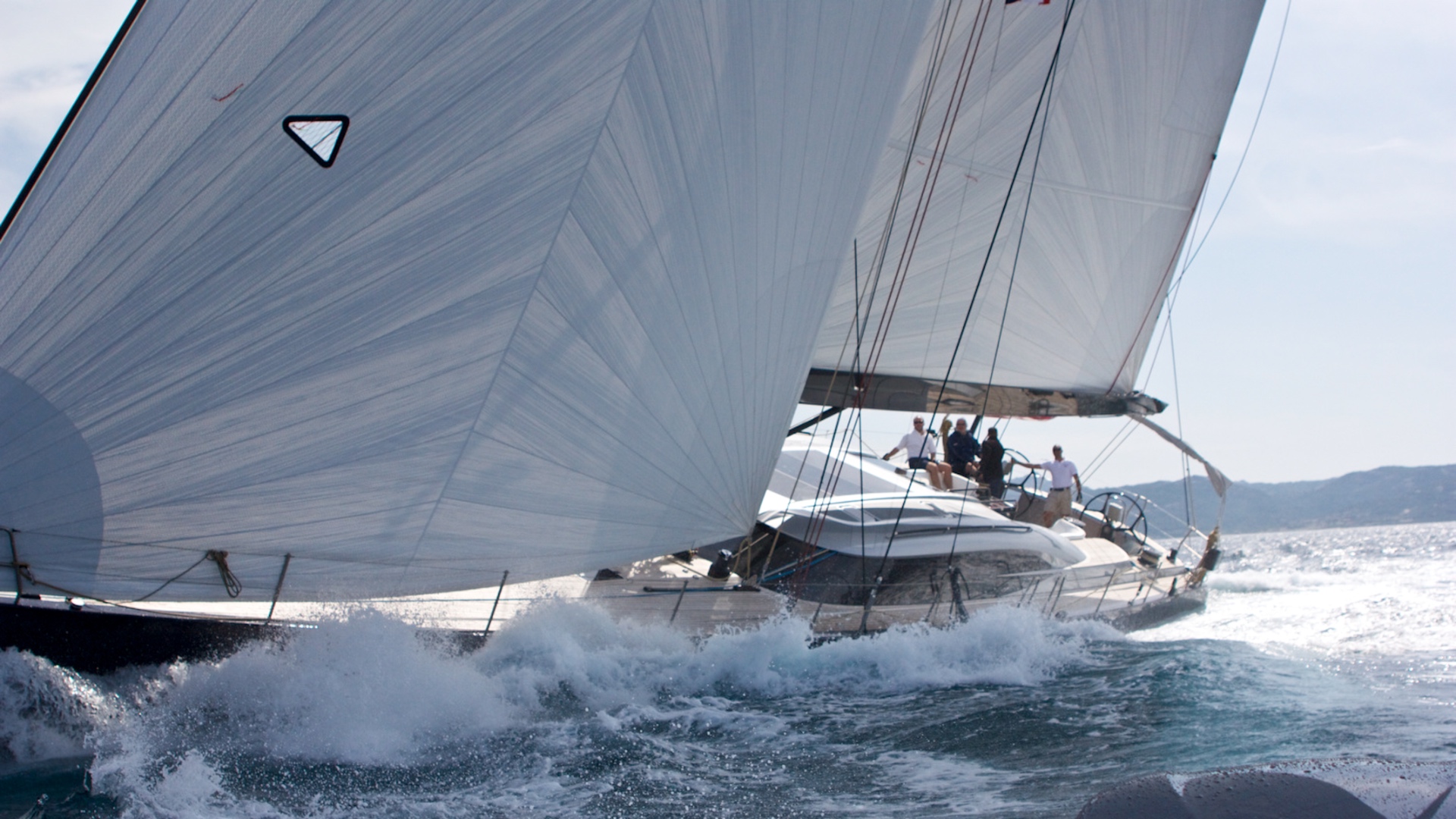
In her Yachting World review, Bambochip was described as an "all carbon super-cruiser" that "weighs only 38 tons." On her test day, she reached eleven knots in ten knots of true wind, a ratio that, in a vessel of this displacement, borders on the uncanny. In stronger conditions, with thirty knots of true wind, the reviewer recorded "17.6 knots on the log."
These numbers are the product of the carbon hull, the lifting keel, the Hall Spars rig, and the obsessive weight management that extends from the excessive use of titanium to the foam-filled furniture and cabinetry. Bambochip sails in conditions that leave most sailboats motoring. Her crew have described the sensation as something approaching magic, nearly defying the laws of physics, as the hull accelerates in air that scarcely fills a flag.
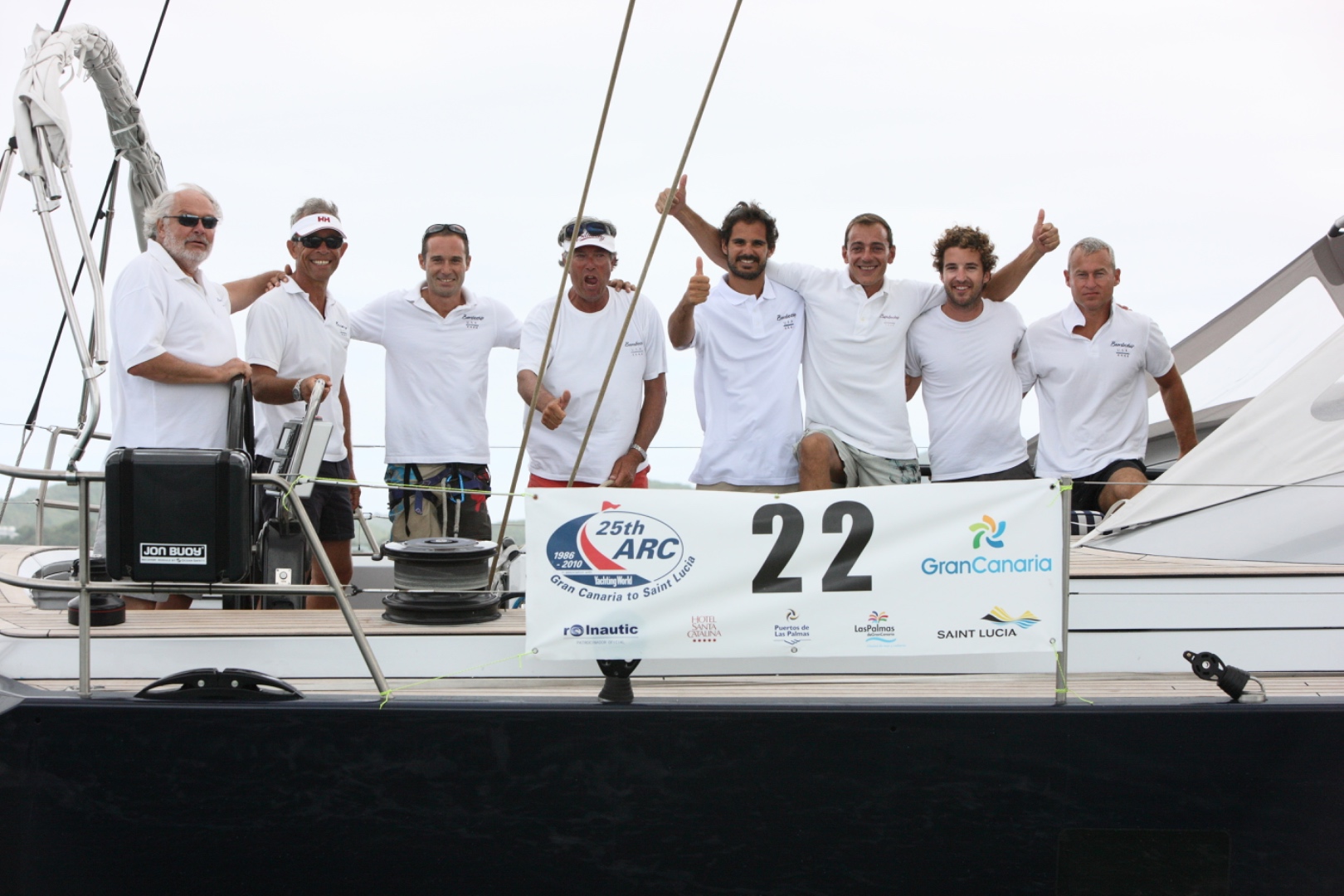
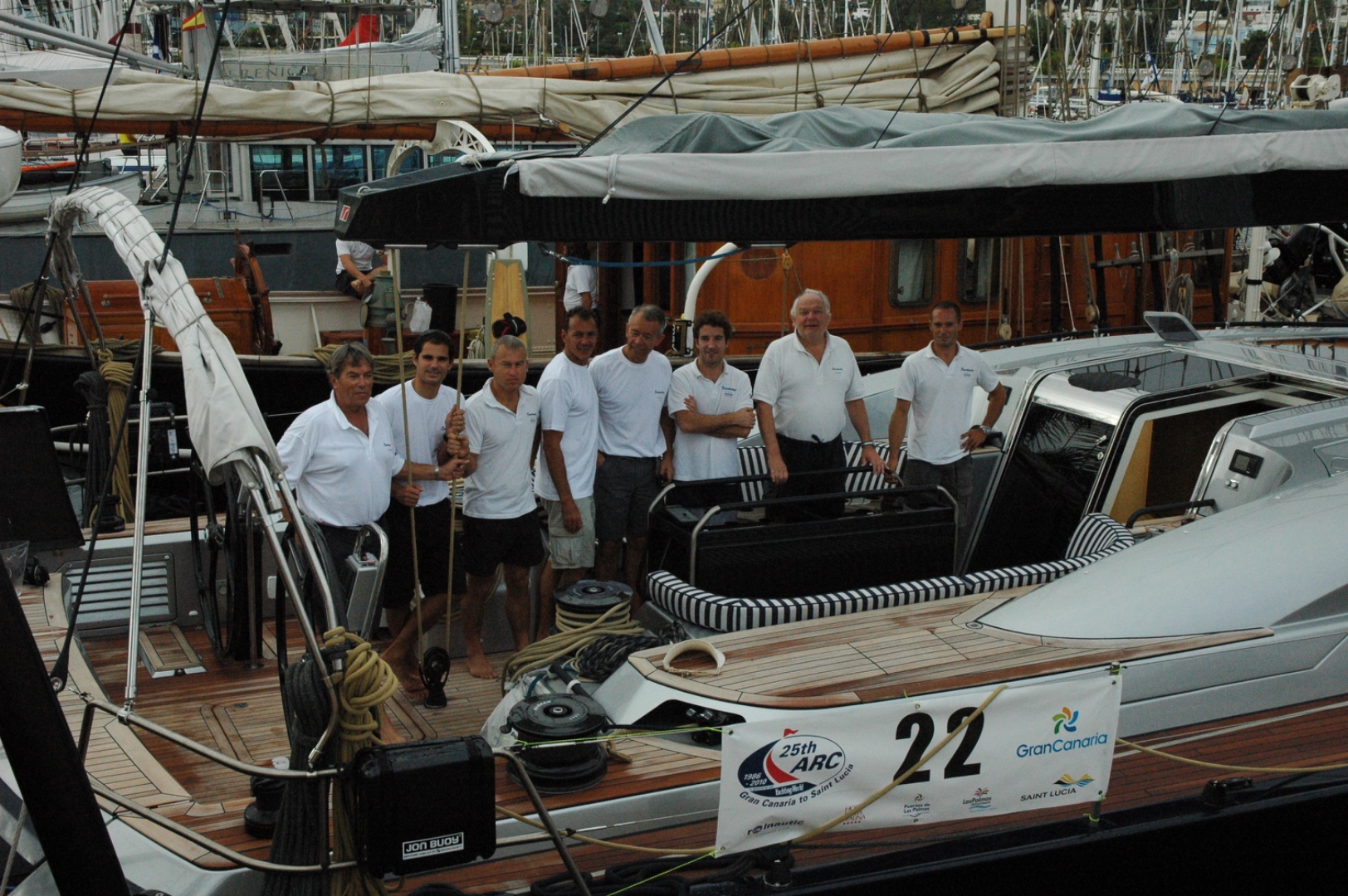
In 2010, Bambochip entered and won the Transatlantic ARC Rally, competing against a fleet that included purpose-built racing yachts and significantly larger vessels. The victory was not marginal. Three hundred-nautical-mile days were the norm, not the exception. The Atlantic has since become a familiar passage: thirteen crossings to date, each one a sustained demonstration of what a lightweight, stiff-hulled, well-rigged yacht can achieve when the engineering is right.
Bambochip has been sailed by former America's Cup and Olympic-class professionals when pushed to her limits in heavy weather and competitive contexts. But the same yacht is docile enough to be handled by a fit and experienced couple in moderate conditions, a range of operability that is the direct result of a well planned deck layout and automation of sail handling through the use of an advanced Cariboni hydraulic system.
This duality, a yacht that can be raced by professionals and cruised by two, is the defining characteristic of the Shipman 80 platform. In Bambochip's case, the custom upgrades extend that range at both ends: faster under professional hands, more manageable under a small crew.
Life Underway
Bruno Bich spent approximately eight months of every year aboard Bambochip, from her delivery in 2010 until his passing in 2021. The yacht was not just a high-performance platform for winning races and regattas. It was also a residence, a working office, and the setting in which he conducted much of his commercial and personal life.
From aboard Bambochip, Bruno managed the Bic Group's global operations, oversaw his vineyard, and administered the family's extensive holdings. He semi-retired aboard, then returned to active management of the company, using the yacht as the unofficial embassy of the Bic Group, a floating headquarters from which he received associates, entertained clients, and even hosted diplomats, in ports from Istanbul to the Galapagos.
The guest list over those years reads as a register of influence. French and foreign dignitaries, high-ranking politicians, a former head of state, and members of some of the world's most prominent families were received aboard. The yacht's appointments, the Rhoades Young interior, the silence of the Northern Lights generator system, the space and privacy afforded by the accommodation plan, made this possible. Bambochip was not simply large enough to host; it was refined enough to host with dignity.
One story from this period is illustrative. During the post-recession years, Bruno visited the Bic factory in Athens at a time when most multinational companies were reducing Greek operations and cutting staff. Bruno chose the opposite course: he shared company profits with the local workforce. Word reached the Greek government. When Bambochip arrived in Piraeus, one of the busiest commercial ports in the Mediterranean, the Greek president ordered the navy to clear a side-tie berth for the yacht. It was an extraordinary gesture, and one repeated in various forms around the world: access to locations, berths, and anchorages generally off-limits to private sailing yachts, extended in recognition of the man and the vessel he inhabited.
In the years before his death, Bruno backed the restoration of France, a twelve-metre America's Cup yacht from his father's era. He and Bambochip's captain sailed France together at Mediterranean regattas. Bruno donated sufficient funding to ensure the yacht could be maintained and sailed for generations, a final act of custodianship from a family for whom sailing was never merely a sport but a way of living in the world.
The 2025 Refit
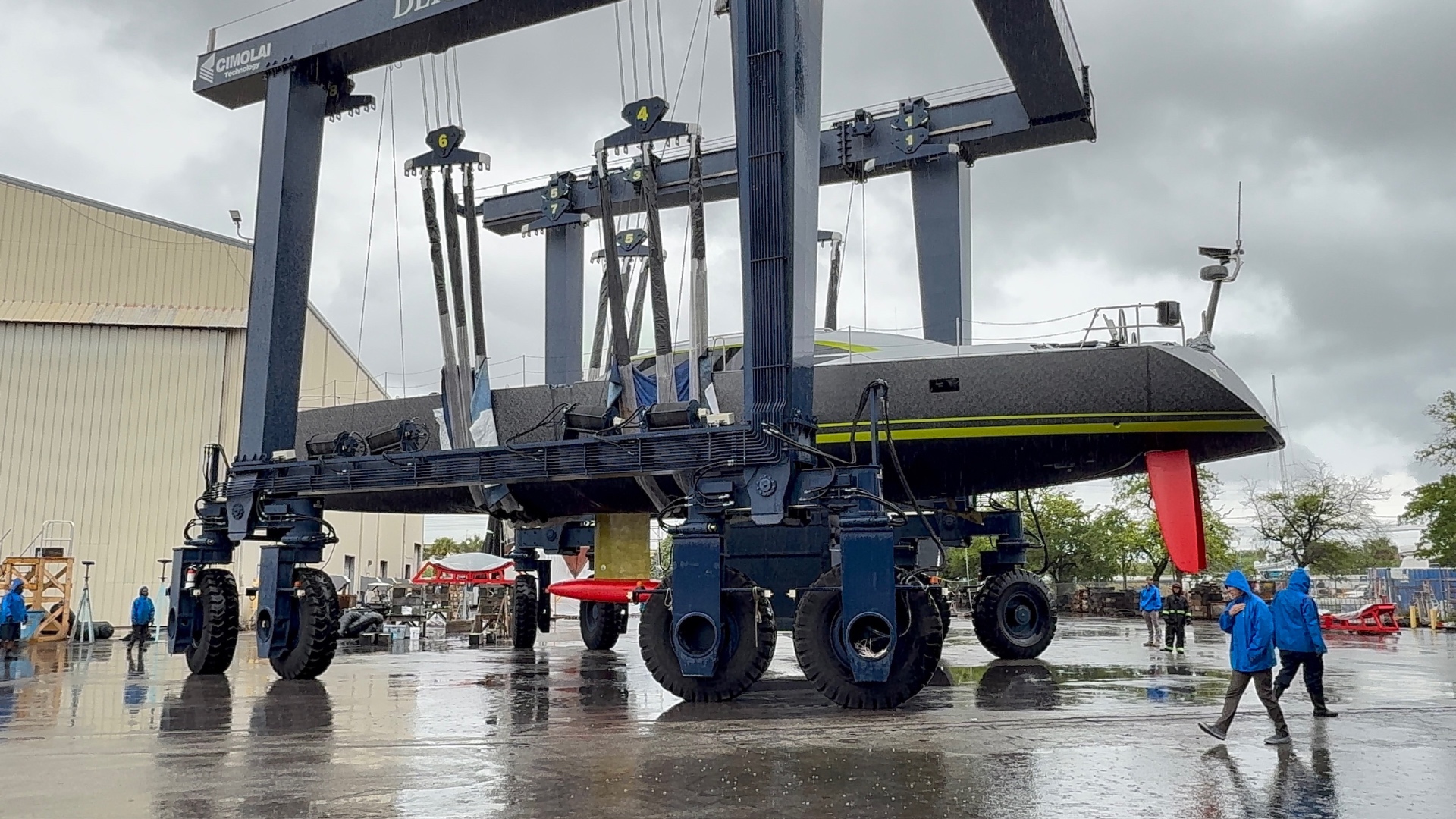
In 2025, Bambochip entered Derektor Shipyard in Florida for a comprehensive modernisation, a refit conceived not as restoration but as renewal, preserving the yacht's original character while replacing, overhauling, or upgrading virtually every system aboard.
Propulsion & Mechanical
Engine
Yanmar 4LHA-STP (240 HP) with new AquaDrive system and four-blade Gori folding propeller with overdrive
Generator
Northern Lights generator: minor overhaul, all new exhaust hoses
Fluid Systems
All tanks cleaned. Nearly every hose replaced. Main bilge pump, waste and sanitation pumps, dual freshwater pumps (redundant), water heater, and grey-water sani-splits all replaced. Seawater manifolds, valves, and strainers fully overhauled or replaced
Watermaker
Overhauled with new membranes and filters, capable of producing 1,200 gallons per day
Climate
Air conditioning serviced with new chiller pump and seawater pump. New propane/butane bottles, solenoid, and control system
Hull, Deck & Structure
Deck
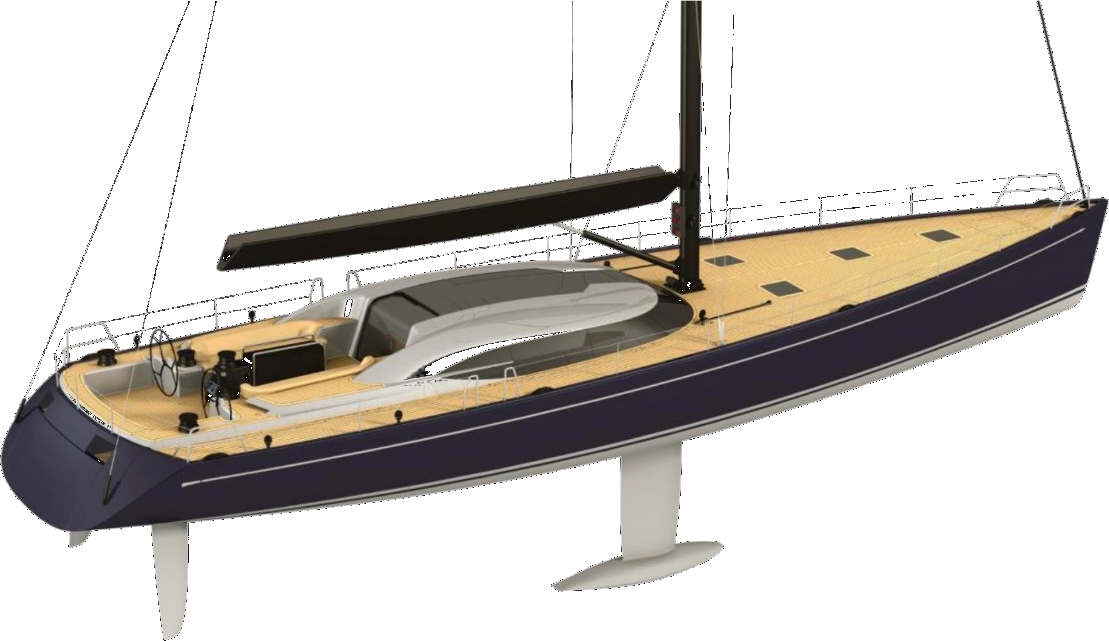
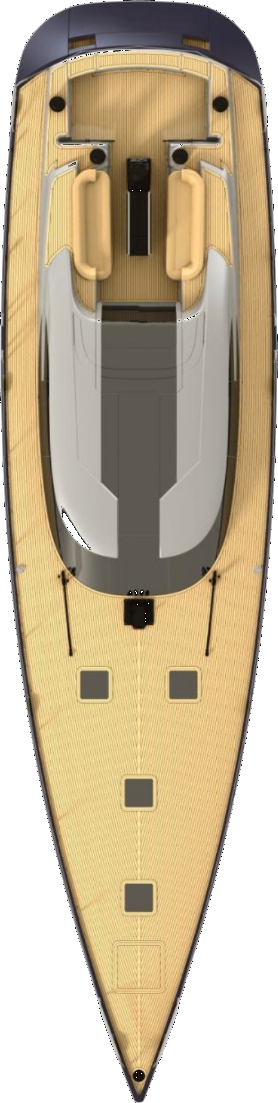
Original teak main deck removed and replaced with custom Flexiteek composite deck, a weight savings of approximately half a tonne
Hull Finish
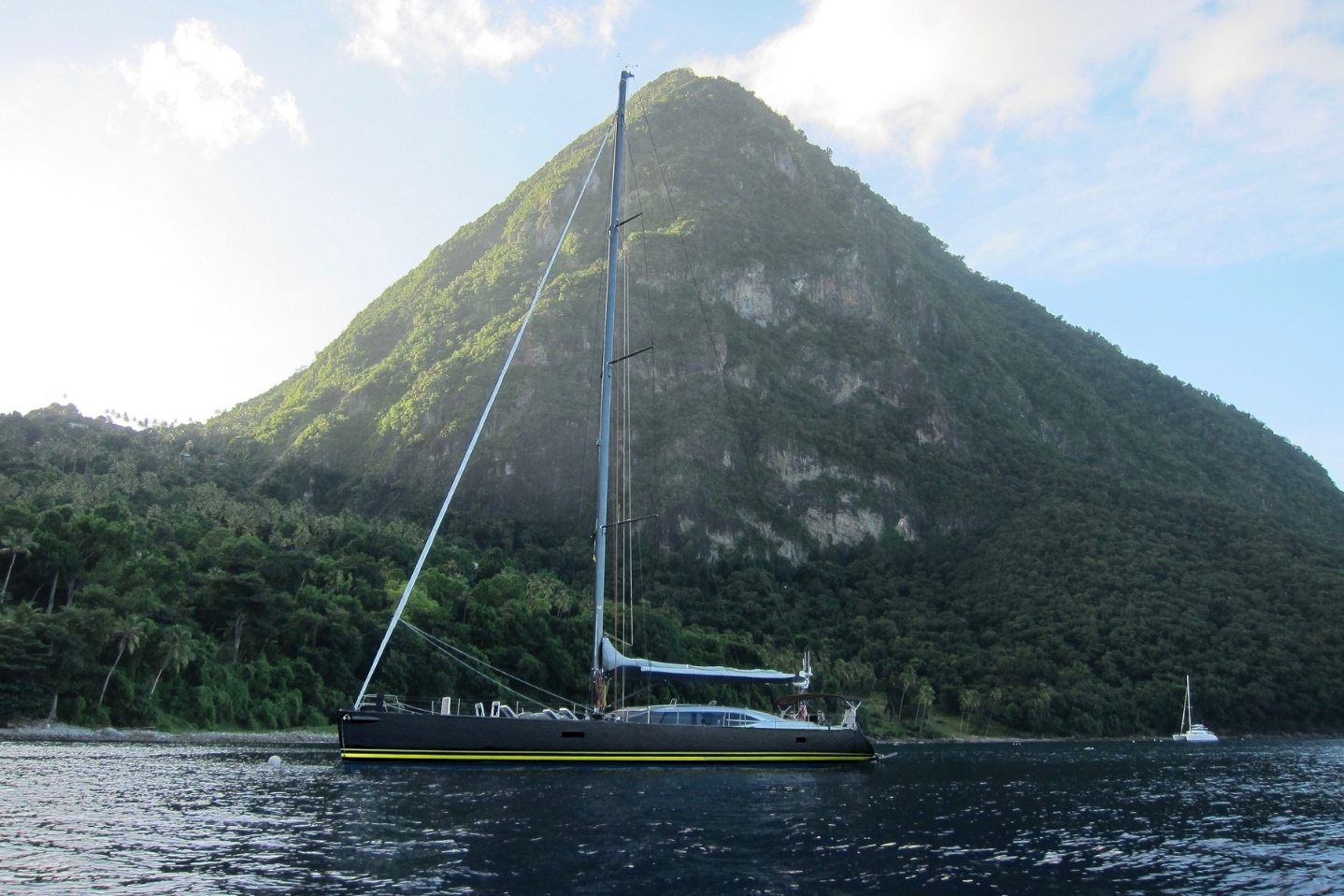
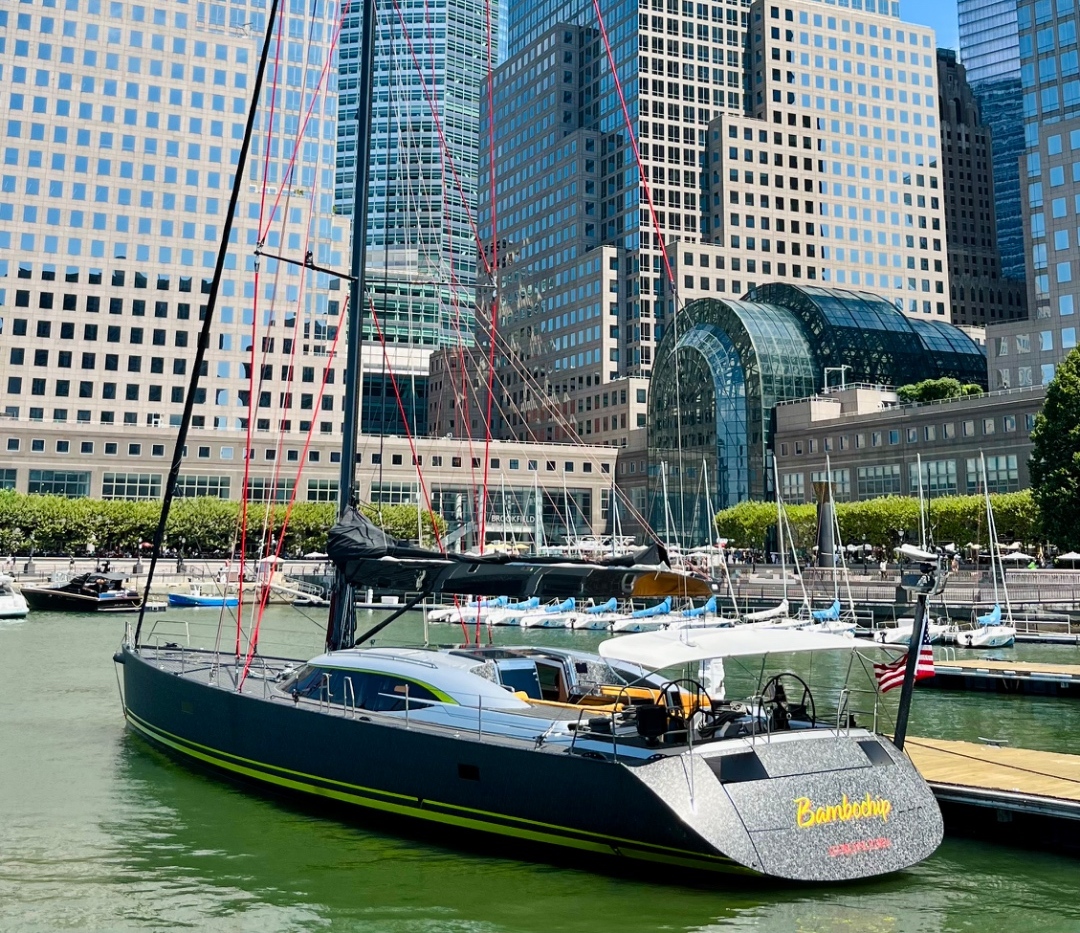
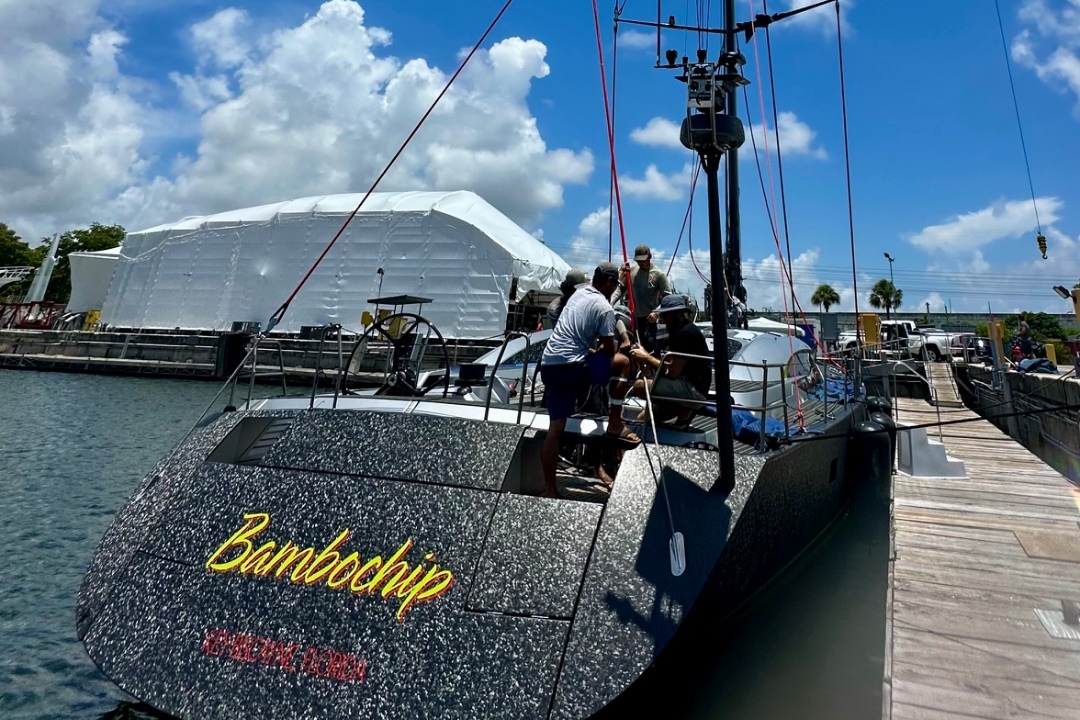
Traditional dark blue hull finish replaced with a custom forged carbon-fibre PPF film that highlights the vessel's carbon construction, an aesthetic that makes the engineering visible
Substructure
All machinery spaces and bilge repainted. Tool storage modified. Custom Seaway-built cradles blasted, epoxy-coated, and painted
Keel, Rudders & Steering
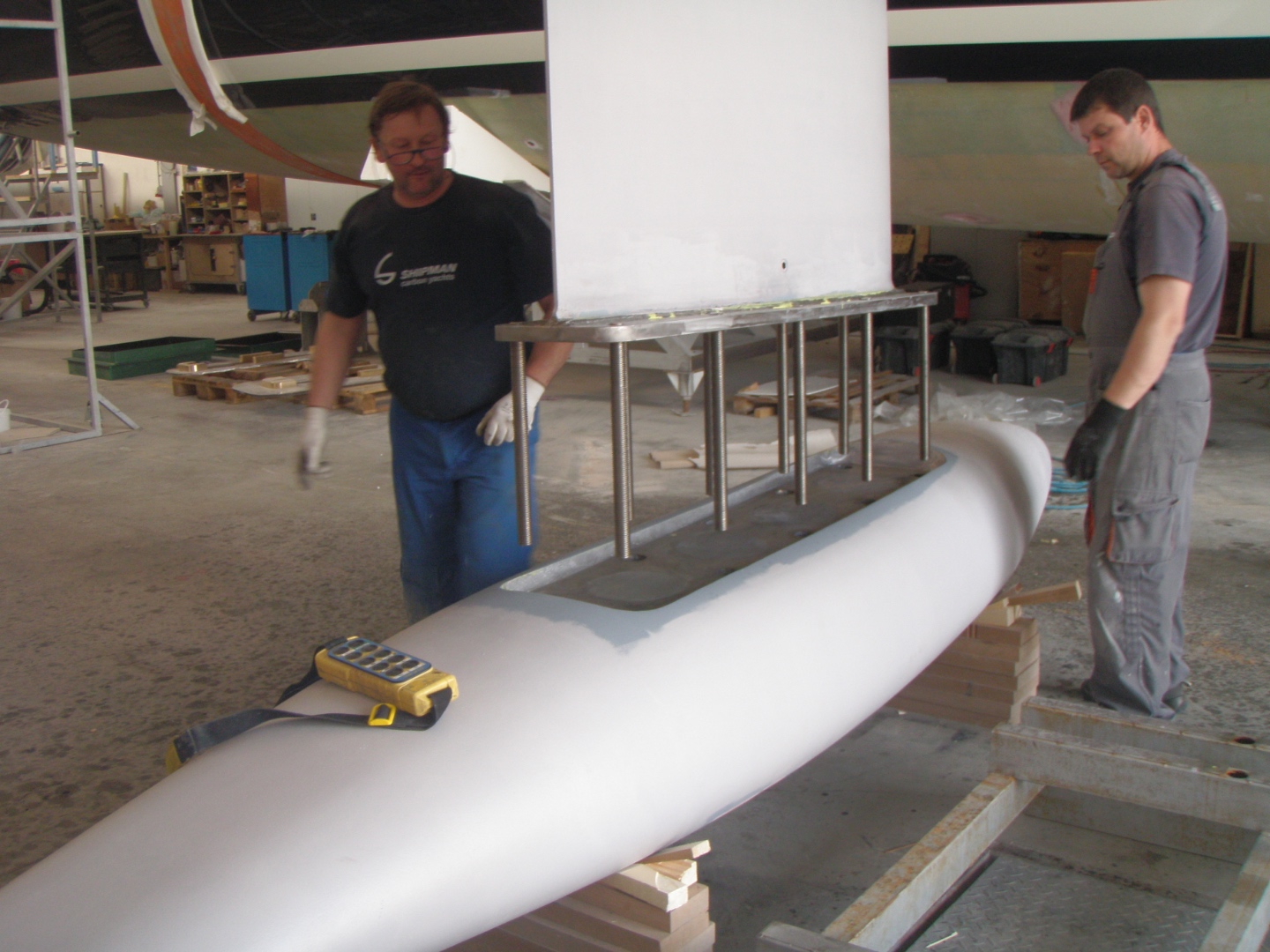
Keel
Removed and fully overhauled, new hydraulic retraction cylinder fitted, bulb nuts inspected, stainless NACA foil finished in PropSpeed
Rudders
Overhauled and refitted with new custom rudder bearings from JP3 France
Auxiliary
Retractable bow thruster overhauled. Hydraulic system overhauled. Steering systems overhauled
Rig & Sails
Carbon Rig
Hall Spars carbon mast and boom removed and overhauled in 2025. Reckmann carbon-fibre headsail furler factory overhauled
Standing Rigging
Colligo Para-D continuously wound Dyneema with Navtec titanium hardware
Sails & Running Gear
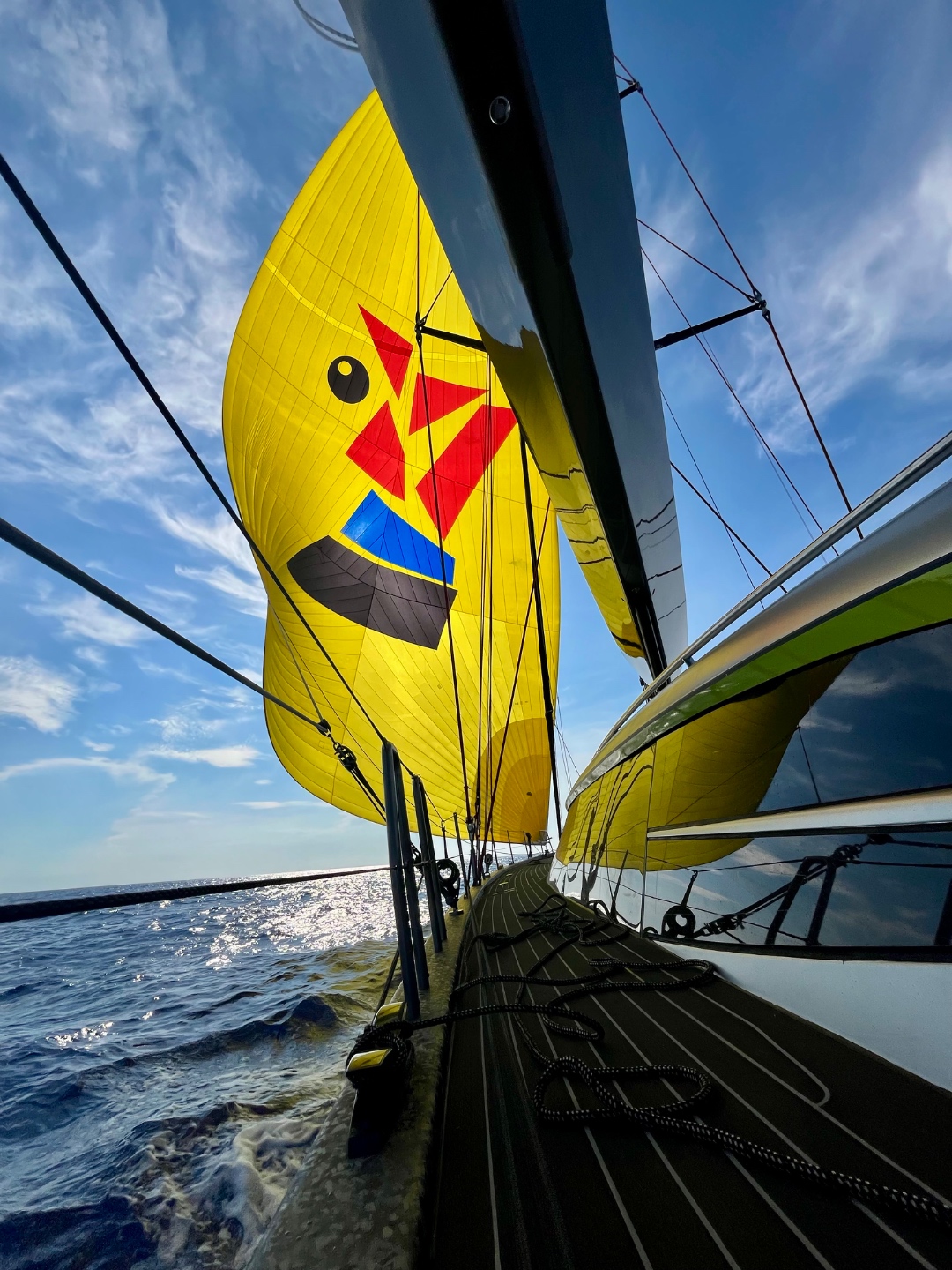
New mainsail and genoa; Code 1, Code 5, and asymmetric spinnaker serviced. All winches, blocks, clutches, and sheaves replaced or serviced. Running rigging updated. Synthetic lifelines fabricated. Carbon-fibre passerelle serviced with new hardware and lines. Retractible bowsprit overhauled
Electronics: Full B&G System, New 2025
Navigation
Zeus 3s (12″ and 9″), VulcanR 7″, H5000 graphic displays, H5000 analogue instruments (×2), Hercules WTP sailing processor, Halo 20 Plus radar, FLIR M332 thermal camera
Autopilot & Wind
H5000 autopilot with H5000 pilot controller and WR10 wireless controller. WS730 carbon wind sensor
Communications
V100-B VHF/AIS with GPS-500 (×2), H50 wireless VHF remote
Connectivity & Entertainment
Network
Maritime Starlink with Pepwave enterprise router and multiple access points throughout the vessel
Audio
Three-zone Sonos audio system
Power & Energy: Victron System, New 2025
Batteries
31 kWh battery bank: (6x) 200 Ah Smart Lithium 25.6 V NG batteries with Lynx Smart BMS 1000A
Inverters
Two Quattro 24/5000/120 charger-inverters in parallel, 10 kW total available power. Two Victron isolation transformers for worldwide voltage and frequency compatibility
Digital Switching
CZone digital switching system for all ship's loads, including electric skylight shades
Impact
The entire , including air conditioning, can run from batteries alone. Generator runtime has been reduced by 80%. The yacht can accept shore power worldwide, regardless of local voltage or frequency standard
Additional Systems & Equipment
Deck & Exterior
New exterior lighting. All deck hatches overhauled or replaced. New stainless steel anchor chain: Grade 60 PLUS by Cromox, 13 mm, 100 metres. Carbon fibre stow-away anchoring arm hydraulics overhauled
Tender
New rigid inflatable yacht tender, stowed in the transom garage and deployed via hydraulic swim platform on wireless remote control
Galley & Domestic
Miele full-size washer and dryer. Custom Force 10 galley stove and oven, plumbed for both propane and butane with individual lockers for each
Spares
Bambochip carries an extensive but logical spare parts package for uninterrupted cruising in remote areas of the world. 2025 package updated and reorganised. Her custom cradles were overhauled and repacked into their shipping container, ready to be dispatched to any port in the world for next hauling-out
Legacy and the Next Chapter
Until 2026, the only way to set foot aboard Bambochip was by private invitation of the Bich family. She has never been available for charter to the public. In a world of sailing yachts marketed and brokered and traded on open markets, Bambochip has remained entirely private, entirely singular.
That changes now. Following the completion of the 2025 refit at Derektor Shipyard and a busy 2025-2026 private cruising schedule, Bambochip will be available for extremely limited charter. This is not a commercial fleet operation. It is a controlled opening of one of the world's most elusive sailing yachts to a small number of guests who understand what they are boarding.
She is also available, by special arrangement, for professional film and television productions, a modern-profile sailing yacht of eighty feet, the visual distinction that production work demands.
The vessel that Bruno Bich conceived as his final yacht, the yacht that crossed the Atlantic thirteen times, won the 2010 Transatlantic ARC Rally, hosted dignitaries and heads of state, and served as the floating embassy of one of France's great families, enters her next chapter as she was built: without compromise, without equivalent, and without apology.
Technical Specifications
| Name | Bambochip |
|---|---|
| Type | Seaway Shipman 80 |
| Hull Number | #2 of 3 built |
| Build Year | 2009 |
| Builder | Seaway (Slovenia) |
| Naval Architecture | J&J Design, Ljubljana |
| Interior Design | Rhoades Young |
| LOA | ~24.00 m / ~80 ft |
| Beam | 5.95 m |
| Draft | 2.5 m (keel retracted) / 4.0 m (keel extended) |
| Displacement | ~38 tonnes |
| Construction | Full carbon-epoxy, vacuum infused, Kevlar-reinforced below waterline |
| Rig | Hall Spars carbon fibre mast and boom |
| Standing Rigging | Colligo Para-D Dyneema with Navtec titanium hardware |
| Hydraulics | Cariboni (bespoke) |
| Engine | Yanmar 4LHA-STP, 240 HP |
| Generator | Northern Lights (custom, 1,500 RPM) |
| Power System | Victron lithium: 6× 200 Ah 25.6 V, 10 kW inverter capacity (new 2025) |
| Electronics | Full B&G suite |
| Connectivity | Maritime Starlink, Pepwave enterprise network |
| Deck | Flexiteek composite |
| Hull Finish | Forged carbon-fibre PPF film |
| Watermaker | 1,200 gal/day capacity |
| Status | Not for sale. Available for limited charter and production work, 2026 |
Enquiries
Bambochip is available for extremely limited charter and professional production engagements beginning 2026. All enquiries are handled directly and confidentially.
Charter Enquiries
For private charter availability, rates, and itinerary planning, please contact the management team directly.
Contact details available upon request
Film & Television
For professional production enquiries, location scouting, and availability, please reach out to discuss requirements and scheduling.
Contact details available upon request